

Pressure is usually the first spec people ask us about, and buyers often assume the highest number is the best choice. It isn’t that simple. The pressure you choose also decides what the chamber is made of, how heavy it is, where it can go, and what kind of business or home routine it fits.
This guide explains what the three common pressure levels mean, which MACY-PAN chambers run at each one, and what changes as you go up.
What “ATA” means
ATA stands for atmospheres absolute. At sea level, the air around you is 1.0 ATA. A chamber at 1.3 ATA holds 30% more pressure than the room outside it. At 2.0 ATA, it holds double.
Product sheets often list pressure in PSI or kPa as well. Those figures count only the pressure added above normal air, which is why the numbers look small:
| Chamber pressure | Added pressure | Roughly the same as |
| 1.3 ATA | about 4.4 psi / 30 kPa | 3 m (10 ft) under water |
| 1.5 ATA | about 7.3 psi / 50 kPa | 5 m (16 ft) under water |
| 2.0 ATA | about 14.7 psi / 101 kPa | 10 m (33 ft) under water |
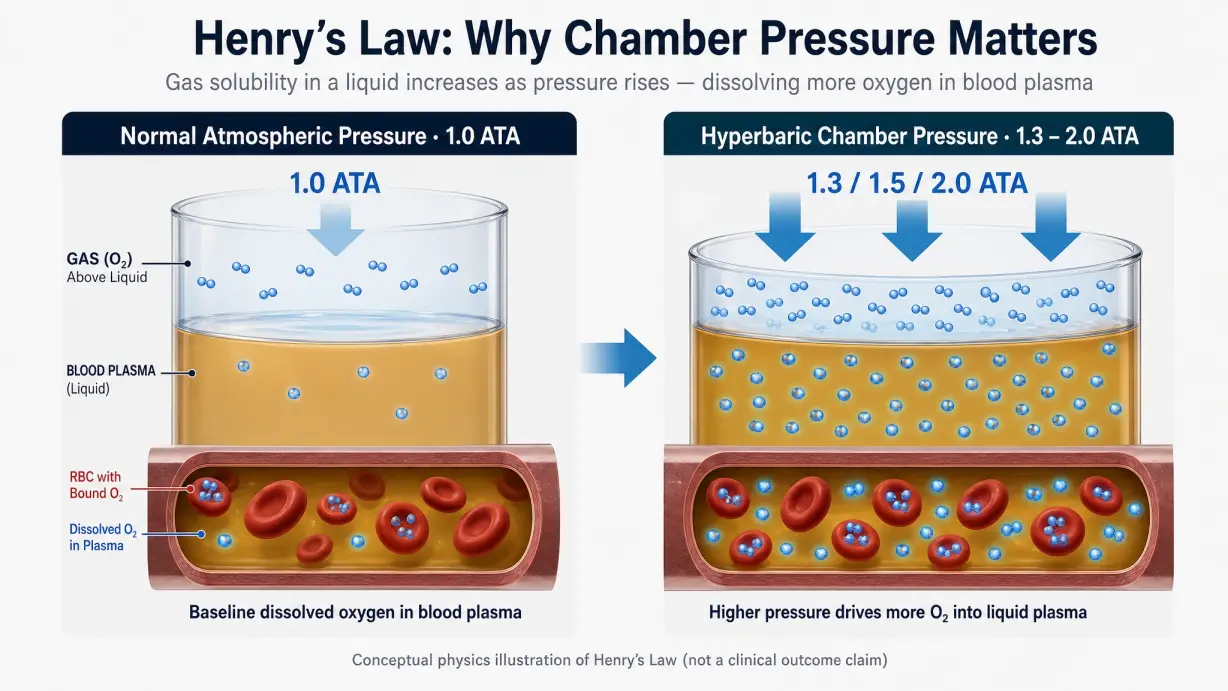
Our catalog explains why pressure matters with Henry’s law: the more pressure on a gas, the more of it dissolves in a liquid. In a chamber, that means more oxygen dissolves in blood plasma as pressure goes up. That principle is the reason people use hyperbaric chambers. How much difference a given pressure makes for a particular person or goal is a medical question, and this article doesn’t try to answer it.
Which MACY-PAN chambers run at which pressure
| Pressure | Chamber type | MACY-PAN models | Build |
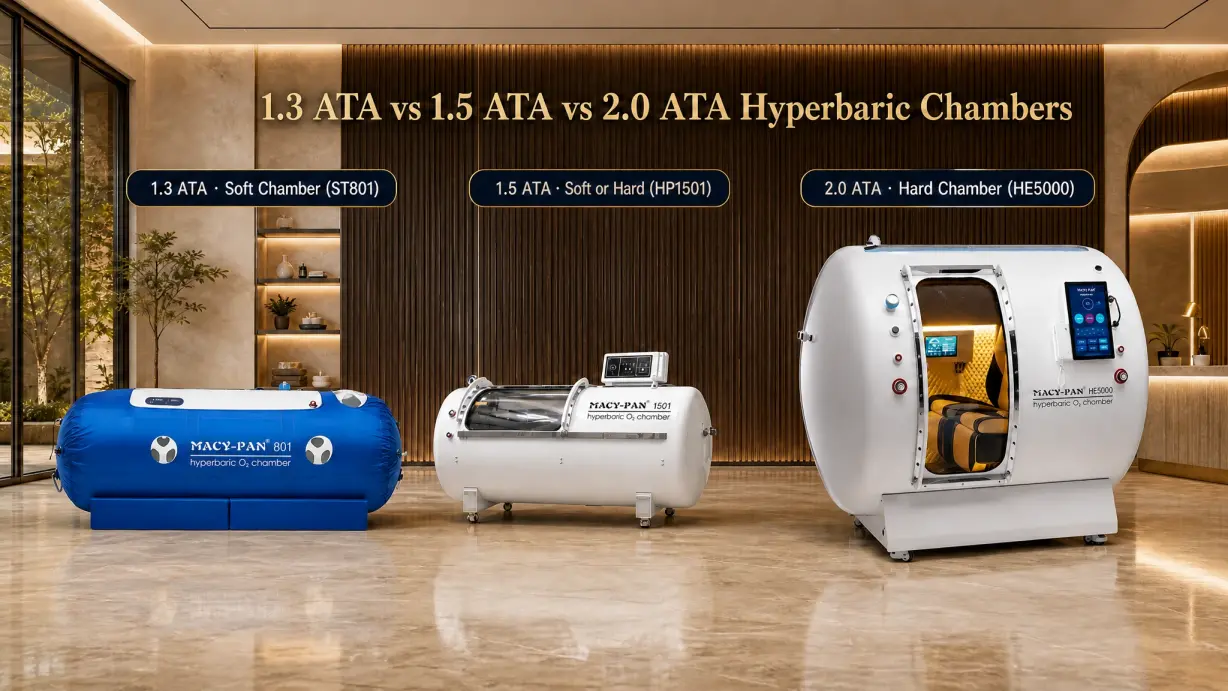
| 1.3 ATA | Soft | ST801, ST901, ST2200, ST1700, L1, MC4000 | TPU with nylon fibre layer, 13–16 kg chamber body |
| 1.4–1.5 ATA | Soft | Same soft models, optional setting | Same as above |
| 1.5 or 2.0 ATA | Hard | HP1501, HP2202, HE5000 | Hard shell, Stainless steel and polycarbonate |
The split matters. Up to 1.5 ATA, you can choose a soft or a hard chamber. At 2.0 ATA, you’re buying a hard chamber. A fabric chamber isn’t built for that pressure.
1.3 ATA: where most home users start
On our ST801 product page we note that 1.3 ATA is the setting most people choose, with 1.4 and 1.5 ATA as options. There are practical reasons for that.
The pressure change is small, so ears have less to adjust to on the way up and down. A soft chamber at this level weighs around 15 kg, folds down for shipping, and can be set up in a spare room or moved later. The oxygen concentrator, air compressor and cooler sit beside it.
The trade-off is that 1.3 ATA is the lowest of the three. If you already know you want higher pressure, starting here and upgrading later means buying twice.
Good fit: home users, first-time buyers, people who are sensitive to ear pressure, and anyone who wants a chamber they can move.
1.5 ATA: the point where you choose soft or hard
1.5 ATA is the only level where both chamber types are an option, and it’s where buyers have the most to decide.
A soft chamber at 1.5 ATA is the same chamber as above, set to a higher pressure. It’s still light, portable and easy to ship.
A hard chamber at 1.5 ATA, our HP1501, is a different kind of product. The HP1501 page compares the two directly. The soft chamber is portable, space-saving, manually operated and suited to homes and offices. The hard chamber is more automatic, easier to get in and out of, and suited to public places like clinics and salons. The HP1501 has a sliding door instead of zippers, internal and external control panels so the user can start and stop a session alone, a built-in intercom, and a water-cooled air conditioning system. It also weighs about 170 kg and needs a fixed spot in the room.
So at 1.5 ATA the pressure is the same, but the experience isn’t. You’re choosing between portability and price on one side, and a more polished, more commercial setup on the other.
Good fit (soft): home users who want a bit more pressure without the size and weight of a hard chamber. Good fit (hard): clinics, salons, recovery studios and wellness centers where clients come in and out all day.
2.0 ATA: hard chambers only
Our HP2202 runs at 2.0 ATA, listed as 14.5 psi on its spec sheet. The HE5000 multi-seat chamber is offered at either 1.5 or 2.0 ATA.
A few things change at this level:
· The pressure change is bigger. Going from 1.0 to 2.0 ATA is more than three times the change of going to 1.3 ATA, so pressurizing and depressurizing take more care, and ear equalization matters more.
· Exiting is handled differently. On our soft chambers, the manual valve can be opened fully to exit quickly at 1.5 ATA and below. The same product page notes this isn’t recommended at 2.0 ATA. Hard chambers manage depressurization through their own controls and emergency valve.
· The chamber is a heavier installation. At 180 kg for the HP2202, you need to plan the room, the delivery route and the floor before you order.
Good fit: facilities that already know they need 2.0 ATA for their programs, and buyers comparing equipment for a professional setting.
What 2.0 ATA does and doesn’t mean
This is where buyers sometimes get confused, so it’s worth being clear.
The Undersea and Hyperbaric Medical Society (UHMS) defines hyperbaric oxygen as a medical procedure that needs a physician’s prescription and oversight. Under its definition, the patient is in a hard chamber that meets the ASME PVHO-1 and NFPA 99 codes, at no less than 2.0 ATA, breathing medical-grade oxygen above 99% purity, usually for 90 to 120 minutes.
Our chambers deliver oxygen from a concentrator. Our spec sheets list 93% ±3% for the hard chambers, and the soft chamber pages list 93% to 96%. So reaching 2.0 ATA on its own doesn’t put a setup into the category UHMS describes. Oxygen source, chamber standards, facility codes and medical supervision all count.
The rules for low-pressure chambers are also stricter than many buyers expect. A 2026 review in Undersea & Hyperbaric Medicine notes that in the United States, soft chambers are FDA-cleared only for acute mountain sickness. The same paper raises safety concerns about using oxygen concentrators with low-pressure chambers.
What this means for you:
· If you plan to offer clinical treatment, talk to your regulator and a hyperbaric physician before you choose any equipment, including ours.
· If you’re setting up a wellness or recovery service, check your local rules on how you can describe and market sessions. Rules differ a lot between countries.
· Whatever the pressure, don’t market a chamber with claims you can’t back up.
How to choose
Answer these four questions and the pressure usually decides itself:
1. Where will the chamber live? If it might move, or you’re short on space, that points to a soft chamber at 1.3–1.5 ATA. If it has a permanent room, a hard chamber is an option.
2. Who will use it? For one household, soft usually makes sense. For a stream of clients, a hard chamber is easier to get in and out of and to operate.
3. Do you need 2.0 ATA for a specific program? If yes, you’re looking at the HP2202 or HE5000. If you’re not sure, ask the professional who will design your program before you buy.
4. What can your site handle? A hard chamber needs a delivery route, floor capacity and power planned in advance. A soft chamber needs a corner and space for its three machines near a power supply.
Questions we hear a lot
Can I change the pressure later?
Our soft chambers are offered at 1.3, 1.4 or 1.5 ATA. Ask us before ordering how the setting is chosen for your unit. A soft chamber can’t be upgraded to 2.0 ATA; that takes a hard chamber.
Is higher pressure always better?
Not for every buyer. Higher pressure brings a heavier chamber, a bigger installation and a bigger pressure change for the user. The right level depends on who uses it and why.
Does a hard chamber at 1.5 ATA give the same pressure as a soft one at 1.5 ATA?
Yes, the pressure is the same. What differs is the build, the entry, the controls, the weight and where the chamber can go.
Need help choosing?
Tell us where the chamber will go, who will use it and whether you have a target pressure in mind. We’ll suggest models at the right level and send the specs. You can reach us through the message form on our website or on WhatsApp.
Post time: Nov-02-2026