

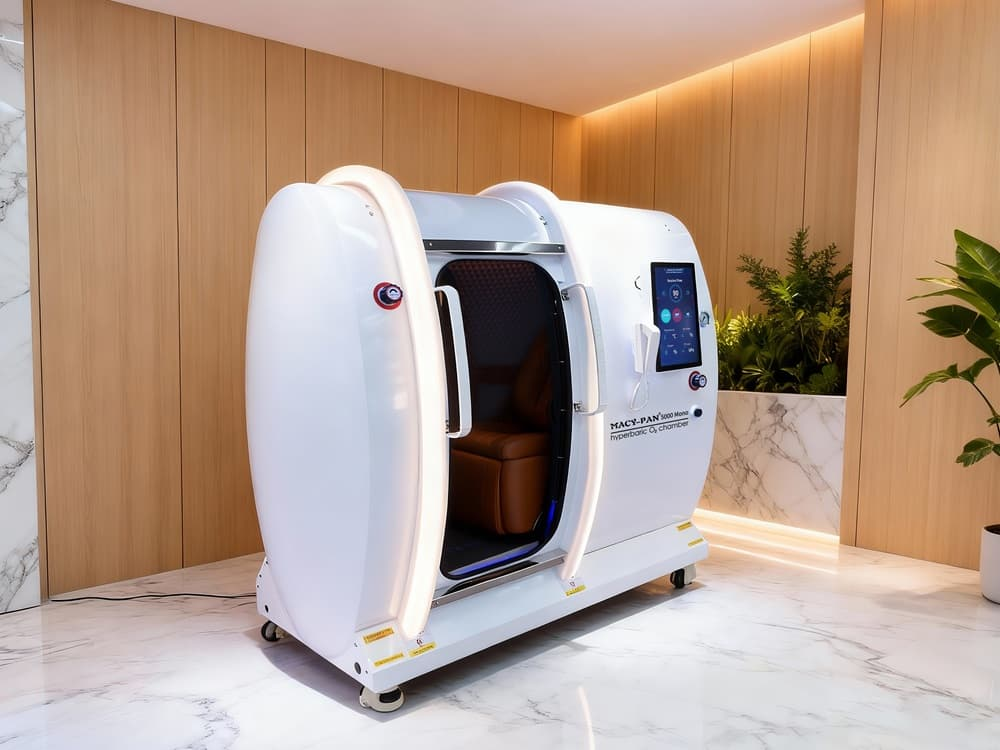
Procurement teams evaluating hyperbaric oxygen therapy (HBOT) equipment for high-end wellness clinics, sports recovery centers, and residential installations face a recurring conflict: medical-grade pressure vessels are traditionally engineered as utilitarian steel cylinders, while the venues installing them increasingly demand interior-design integration. A monoplace hyperbaric chamber operating at 2.0 ATA must satisfy ASME PVHO-1 structural intent, deliver reliable single-occupant oxygenation, and — for the premium B2B segment — function as a visible asset in the space it occupies.
The Macy-Pan HE5000-Mono 35-inch vertical sitting chamber is engineered against this specification. This review breaks down its pressure architecture, finish technology, and lighting subsystem, then maps the unit against typical clinic and residential deployment scenarios.
Key Takeaways:
- Hard-shell vertical monoplace design rated at 2.0 ATA working pressure, 35-inch internal diameter, seated configuration.
- Exterior finished with automotive-grade baking paint; supports custom liveries and RGB ambient lighting.
- Targets high-ARPU clinics, athlete recovery suites, and luxury residential installations where aesthetics drive purchase decisions.
Technical Core: Pressure Architecture and Finish Engineering
The HE5000-Mono is a hard-shell monoplace chamber - a rigid pressure vessel designed for one occupant, distinct from soft-sided inflatable chambers limited to ~1.3 ATA. Hard-shell construction permits a sustained working pressure of 2.0 ATA (approximately 202 kPa absolute, or 1 bar gauge), which is the threshold widely referenced in clinical HBOT protocols for meaningful tissue oxygenation gains beyond what mild HBOT delivers.
Vessel geometry. The 35-inch (≈889 mm) internal diameter is sized for seated occupancy, allowing the user to read, use a tablet, or rest upright. Vertical orientation reduces the equipment footprint to roughly the floor area of a single armchair, a meaningful constraint in urban clinic floor plans where each square meter carries direct revenue cost.
Finish system. The exterior uses a multi-stage automotive baking paint process — the same primer-basecoat-clearcoat sequence applied to passenger vehicles, cured at elevated temperature. Compared with single-coat industrial enamel typically found on medical pressure vessels, this process yields:
- • · Higher film hardness and scratch resistance.
- • · Improved resistance to humidity, cleaning agents, and UV-induced color shift.
- • · A high-gloss surface that can be polished and maintained over a multi-year service life.
Ambient lighting subsystem. RGB LED strips are integrated along the chamber base and contour lines, controlled via remote or mobile application. From an engineering standpoint, the relevant design choices are low-voltage DC operation (isolated from the pressure envelope), sealed strip housings, and tunable color temperature — allowing the operator to match clinical white during treatment intake and shift to warmer tones during the session itself.
Customization. Exterior graphics, brand liveries, and non-standard color matches are supported as a factory option. For multi-site operators, this enables consistent branding across locations without aftermarket vinyl wraps that degrade under cleaning protocols.
Application Scenarios and Deployment Considerations
The HE5000-Mono is positioned for three distinct B2B buyer profiles, each with different selection priorities.
1. Premium Wellness and Longevity Clinics
These operators charge per-session rates that depend heavily on perceived environment quality. A chamber that visually reads as medical equipment undermines the spa-adjacent positioning. The HE5000 Mono's finish and lighting allow the device to function as a room centerpiece rather than equipment to be hidden behind a curtain.
2. Athlete and Sports Recovery Facilities
Throughput and session comfort are the dominant variables. The seated 2.0 ATA configuration supports recovery protocols of 60-90 minutes without requiring the athlete to lie prone, which is preferred by users who want to review footage or communicate with coaching staff during the session.
3. High-End Residential Installations
For residential buyers, the chamber competes for floor space with furniture. Custom paint and ambient lighting allow integration into media rooms, primary suites, or dedicated wellness rooms without the institutional appearance of clinical equipment.
Comparative Analysis: Conventional Monoplace vs. HE5000-Mono
| Dimension | Conventional Steel Monoplace | HE5000-Mono 2.0 ATA |
|---|---|---|
| Working pressure | 2.0-3.0 ATA (varies) | 2.0 ATA hard-shell |
| Exterior finish | Single-coat industrial enamel | Multi-stage automotive baking paint |
| Color/branding options | Typically white or beige only | Multiple colors + custom liveries |
| Ambient lighting | None or basic interior LED | RGB programmable, app-controlled |
| Footprint orientation | Horizontal (lying) dominant | Vertical seated, ~1 m² footprint |
| Typical service life of finish | 5-7 years before refinishing | 8-10 years under standard cleaning |
| Target deployment | Hospital / clinical | Premium clinic / residential / sports |
Selection Checklist for Procurement
- Confirm pressure protocol alignment. If treatment plans call for ≥1.5 ATA, soft chambers are non-viable. The 2.0 ATA hard-shell rating covers the standard clinical operating range.
- Verify floor loading and room dimensions. Vertical chambers concentrate weight on a smaller footprint; check structural slab specifications for residential installations above ground floor.
- pecify ventilation and oxygen supply. Plan for the oxygen concentrator or cylinder feed line, exhaust routing, and ambient room ventilation.
- Define the finish package early. Custom paint and graphics extend lead time; lock the color and livery specification before order confirmation.
- Plan operator training. Even with simplified controls, staff should be certified on pressurization, emergency depressurization, and occupant communication protocols.
- Budget for maintenance. Door seals, pressure gauges, and oxygen sensors are consumables with defined replacement intervals.
Frequently Asked Questions
Is mild HBOT worth it?
Mild HBOT (typically 1.3 ATA, soft-shell) produces measurable but limited increases in dissolved plasma oxygen compared with 2.0 ATA hard-shell protocols. For wellness, recovery, and general circulation support, mild HBOT has a defensible use case. For clinical indications where higher partial pressures of oxygen are the active mechanism, a 2.0 ATA hard-shell unit like the HE5000 Mono is the appropriate specification.
How long do HBOT results last?
Duration depends on the indication and protocol. Acute recovery effects - reduced muscle soreness, perceived energy - are typically observed within 24-72 hours post-session. Cumulative effects from multi-session protocols (commonly 20-40 sessions) can persist for months, though maintenance sessions are standard practice in athletic and longevity programs. There is no single industry-wide figure; effect persistence is protocol and indication-specific.
Why does Justin Bieber sleep in a hyperbaric chamber?
Public figures using home hyperbaric chambers typically cite recovery, sleep quality, and general wellness rationales. From a market standpoint, high-profile residential use has driven demand for chambers that meet medical pressure specifications while integrating into domestic interiors - which is the design brief the HE5000-Mono addresses.
What are the installation requirements?
A single-phase power supply, an oxygen source (concentrator or cylinder bank), adequate room ventilation, and clearance around the chamber for door operation and service access. Detailed site requirements are provided in the technical installation guide on request.
Next Steps
The HE5000-Mono is built around a specific thesis: that the premium HBOT segment now requires equipment engineered to both pressure-vessel standards and interior-design standards simultaneously. Operators specifying for clinics, recovery centers, or residential clients should evaluate it against that brief rather than against utility-grade clinical chambers.
For full technical specifications, custom finish samples, or to discuss a multi-unit deployment, contact the Macy-Pan engineering team to request the HE5000-Mono technical datasheet and a customization consultation.
Post time: Jul-13-2026