

When it comes to orthopedic treatment, most people are familiar with the well-trodden paths of surgery, immobilization, and rehabilitative exercises. However, there’s an invaluable ally lurking “in the hyperbaric chamber”-hyperbaric oxygen therapy (HBOT). Unlike surgical tools or pain medications, HBOT promotes healing through “precise oxygen supplementation,” aiding in swelling reduction, bone consolidation, and more effective recovery of neurological function.
For many people who have struggled with hard-to-manage orthopedic issues that don’t improve with conventional treatments alone, this under recognized therapy can often bring unexpected improvements to recovery. It has been widely integrated into standard clinical protocols for a range of orthopedic indications from non-healing bone fractures to post-surgical wound complications, helping patients get back to daily life faster and with better long-term outcomes. To understand how it exerts these healing effects, we first need to clarify what exactly hyperbaric oxygen therapy is.
What is Hyperbaric Oxygen Therapy?
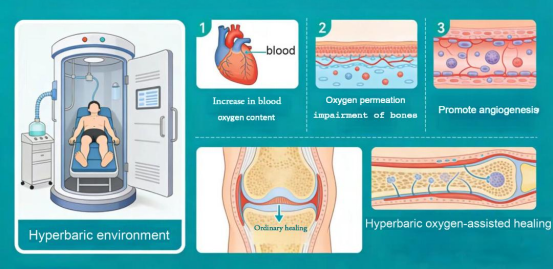
Hyperbaric Oxygen Therapy involves placing patients in a sealed chamber where they breathe pure or high-concentration oxygen at pressures greater than one atmosphere. Unlike standard oxygen therapy, where oxygen is primarily transported by red blood cells, HBOT allows a large amount of oxygen to dissolve directly into the plasma. This effectively enhances the oxygen levels in the blood, allowing it to reach the most profound tissues in the body. Think of it as upgrading from a “bus delivery” to a “high-pressure pipeline,” ensuring that oxygen-deprived tissues receive the energy they need to heal.
This fundamental difference in how oxygen is delivered makes HBOT uniquely effective for treating many hard-to-heal orthopedic conditions that don’t respond well to standard treatments. Many of these conditions stem from reduced blood flow to damaged areas, which leaves tissue starved of the oxygen it needs to regenerate and fight off infection. By directly boosting oxygen concentration in bodily fluids, HBOT bypasses narrowed or damaged blood vessels to deliver this critical healing resource, setting the stage for more effective recovery.
How Does Hyperbaric Oxygen Aid Bone and Soft Tissue Repair?
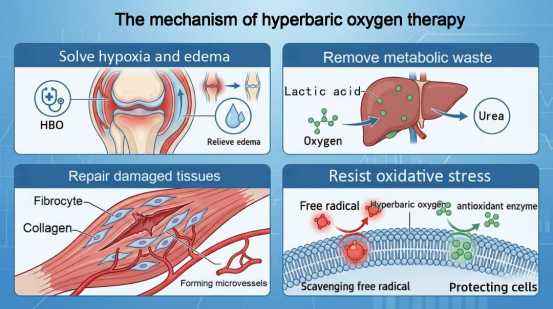
The core functions of hyperbaric oxygen in orthopedics can be summarized in four key areas:
1. Promotes Fracture Healing and Accelerates Callus Formation
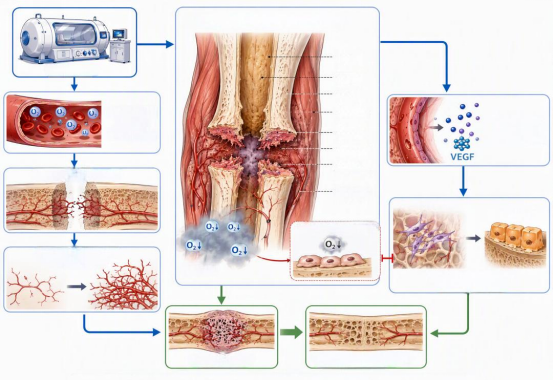
Hyperbaric oxygen significantly elevates arterial oxygen partial pressure through blood circulation, which promotes callus formation and expedites the fracture healing process. This repair involves a significant energy demand, and osteoblasts (the cells responsible for bone formation) falter in hypoxic conditions. HBOT promotes the regeneration of damaged capillaries and enhances blood supply to the fractured area.
2. Reduces Postoperative Swelling and Quickly Alleviates Pain
Swelling at surgical sites is a common hurdle faced by orthopedic patients, often leading to intense pain and hampering wound healing and early functional exercises. HBOT effectively constricts local blood vessels, reduces exudates and edema, and quickly alleviates tension-related pain.
3. Anti-inflammatory and Antibacterial Effects, Reducing Complication Risks
One of the most dreaded complications post-orthopedic surgery is infection. HBOT regulates immune responses, suppressing pro-inflammatory factors and enhancing anti-inflammatory actions, effectively mitigating local inflammation. Importantly, it increases oxygen concentration at the infection site, enhancing white blood cell bactericidal capabilities and directly inhibiting anaerobic bacteria.
4. Nerve Protection and Enhanced Functional Recovery
For patients with fractures accompanied by spinal cord or peripheral nerve injuries, restoring nerve function can be more challenging than bone healing. Nerve cells are highly sensitive to hypoxia; HBOT can reduce nerve edema, dissolve micro-thrombi, and inhibit free radical damage, creating a conducive environment for nerve repair. Studies have shown that combining HBOT with internal fixation for acute spinal fractures aids in postoperative neurological function recovery.
Hyperbaric Oxygen as an “Accelerator” for Soft Tissue Repair Post-Injury
With the rising popularity of fitness, common sports injuries such as ankle sprains, muscle strains, and ligament tears are on the rise. These injuries typically involve inflammation, swelling, pain, and functional limitations, with recovery phases potentially taking several weeks. Here, hyperbaric oxygen acts as both an “accelerator” and “amplifier”-by increasing oxygen pressure in damaged areas, reducing swelling, and promoting micro-capillary regeneration and collagen fiber organization, it significantly shortens recovery periods. For sports enthusiasts and professionals, this translates to a safer, quicker return to activity.

What Orthopedic Conditions Can Hyperbaric Oxygen Therapy Address?
HBOT can be particularly beneficial for a variety of orthopedic issues:
1. Delayed or Non-Union Fractures: Some patients experience slow healing after fractures despite appropriate stabilization. This is often due to inadequate blood flow to the fracture site, leading to a lack of oxygen. When combined with proper fixation of fractures, HBOT can significantly enhance the oxygen delivery to the fracture ends and stimulate bone regeneration for difficult-to-heal fractures.
2. Early Stage Avascular Necrosis of the Femoral Head (Stage I & II): For patients in the early stages of this condition, where the femoral head has not yet collapsed or deformed, HBOT can improve local blood supply, reduce bone marrow edema, and relieve joint pain, effectively delaying or preventing further deterioration and the need for surgery.
3. Severe Limb Injuries, Crush Injuries, and Compartment Syndrome: After traumatic injuries resulting from accidents or crushing forces, HBOT can swiftly reduce swelling, repair damaged muscles and nerves, and minimize the area of necrosis, thereby safeguarding limb functionality and reducing the risk of amputation.
4. Spinal Cord Injuries:
Acute Spinal Cord Injuries (Golden Window for Treatment): The first 4-6 hours post-injury is the optimal intervention window. HBOT can significantly mitigate secondary injuries and establish a foundation for nerve function recovery in both complete and incomplete spinal cord injuries.
Recovery Period for Spinal Cord Injuries: Between 3-6 months post-injury is critical for recovery. Continuous HBOT can consistently improve microcirculation, promote residual nerve function recovery, and minimize long-term complications.
Specific Injury Types: The effectiveness of HBOT is especially pronounced in cases of spinal cord injuries without fractures or dislocations, postoperative residual nerve injuries, and spinal cord contusions, facilitating rapid symptom relief and functional recovery.
5. Chronic Osteomyelitis and Open Fracture Infections: Osteomyelitis can be a challenging issue within orthopedics, often recurring and associated with anaerobic bacterial infections. HBOT, along with surgical debridement and antibiotics, can suppress anaerobic bacteria in a high-oxygen environment, clear deep-seated infections, and promote wound healing—particularly vital for open fractures complicated by gas gangrene or severe infections.
Common Misconceptions Clarified
Myth 1: Patients with internal fixation devices (plates, screws, rods) cannot undergo HBOT.
This is a widespread misconception. Metal internal fixation devices are not contraindications for Hyperbaric Oxygen Therapy, and treatment can proceed safely.
Myth 2: HBOT can replace surgical intervention.
This is absolutely untrue. HBOT is an adjunct therapy; foundational surgical interventions, such as fracture stabilization, wound debridement, and infection management, remain the core of treatment. HBOT is designed to expedite recovery and minimize residual complications, not to replace surgical procedures.
Myth 3: All fractures require HBOT.
Not all fractures necessitate hyperbaric treatment. Typical minor fractures that heal well with conservative management do not require HBOT. The therapy primarily targets challenging, severe, ischemic, or recurrent infection cases.
Conclusion: Hyperbaric Oxygen as the “Accelerator” for Difficult Orthopedic Repairs
In summary, hyperbaric oxygen therapy serves as a powerful tool for addressing issues such as local ischemia, tissue hypoxia, swelling, slow healing, stubborn infections, and challenging tissue repair. It is not simply an additional oxygen infusion; it is a scientifically validated treatment protocol that improves the microenvironment, promotes tissue healing, controls inflammation, and protects limb function. As a vital adjunct in orthopedic practice, HBOT supports patients by shortening recovery times, reducing infection risks, and enhancing healing outcomes.
In essence, for patients with orthopedic injuries characterized by local ischemia, tissue hypoxia, edema, slow healing, stubborn infections, or tissue repair difficulties, Hyperbaric Oxygen Therapy offers significant benefits. This therapy is not a mere “increase of oxygen” but a scientifically validated approach designed to enhance local microenvironments, promote tissue repair, manage inflammatory responses, and preserve limb functionality. As an essential adjunctive modality in the clinical treatment of orthopedic challenges, it effectively addresses pathological issues that conventional treatments struggle to resolve, aids in shortening recovery times, and reduces the risks of unresolved infections and long-term functional impairment.
If you or a loved one are struggling with slow fracture healing, persistent swelling after surgery, recurrent sports injuries, or chronic osteomyelitis, consulting with a specialist about the suitability of hyperbaric oxygen therapy could be a beneficial step toward recovery.
Even for people living with spinal cord injuries, it can still make a tangible difference to recovery when applied appropriately at the right treatment stage. For people who have sustained an acute spinal cord injury, starting adjuvant HBOT within the appropriate window after surgery can often reduce the extent of permanent tissue damage, creating better conditions for subsequent functional rehabilitation. For people with chronic pressure ulcers that are slow to heal after spinal cord injury, HBOT can also promote tissue repair and reduce the risk of serious infection, improving long-term quality of life.
Note: Hyperbaric Oxygen Therapy should be undertaken with a thorough assessment by orthopedic and hyperbaric medicine specialists, ensuring the exclusion of contraindications such as pneumothorax and serious pulmonary conditions before devising a personalized treatment plan. Avoid blind treatments.
Post time: Sep-28-2026