

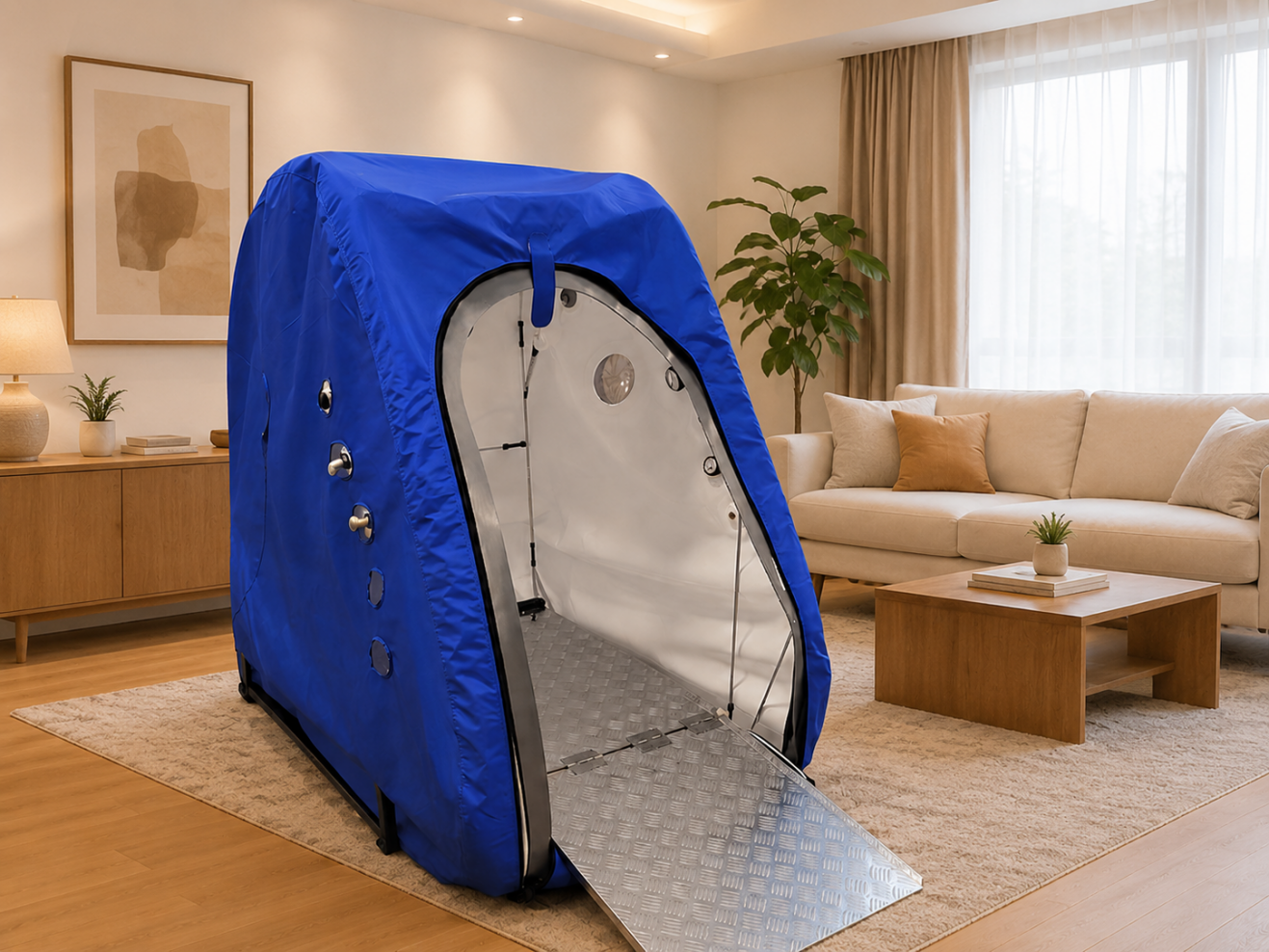
Accessibility is often treated as an operational detail when businesses evaluate a wheelchair accessible hyperbaric oxygen chamber. In practice, it is a much broader equipment-selection issue. Conventional soft hyperbaric chambers are commonly designed around users who can independently transfer from a wheelchair to a chamber bed or seat. That transfer requirement can create additional staff workload, space requirements, and user discomfort.
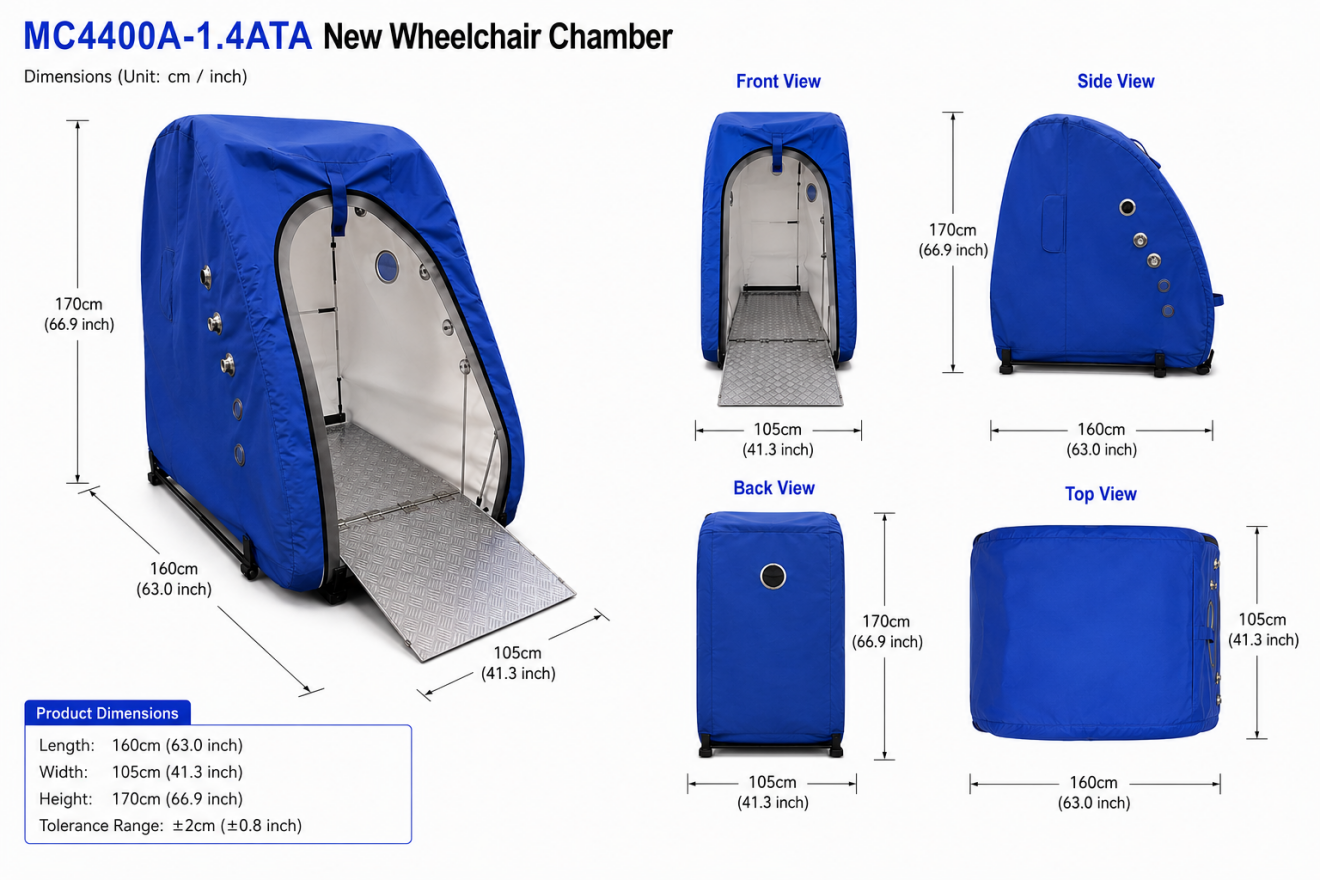
The MACY-PAN MC4400A takes a different approach: the chamber is designed around direct wheelchair access, with a wide entrance, alloy pedals, internal and external controls, and a sitting configuration. Its working pressure is 1.4 ATA, with a chamber size of 160 × 105 × 170 cm (63 × 41.3 × 66.9 in) and a rated capacity of one person.
Key Takeaways
- ➔ A wheelchair-accessible chamber should be evaluated as an accessibility and workflow solution, not simply as another HBOT chamber.
- ➔ The MC4400A uses a soft-shell structure with TPU and nylon materials and a dedicated wheelchair-access design.
- ➔ Its 1.4 ATA working pressure, dual control configuration and emergency-release functions make it suitable for businesses prioritizing accessible wellness and rehabilitation environments.
- ➔ For B2B buyers, the most important factors are access geometry, pressure control, emergency operation, maintenance, available space and long-term service support.
Technical Core: How a Wheelchair Accessible Soft Chamber Works
A hyperbaric oxygen chamber operates by increasing the ambient pressure around the user. In a soft-shell system, the chamber enclosure is a flexible pressure vessel rather than a rigid metal cylinder. The increased chamber pressure allows oxygen to be delivered through the supplied oxygen system while the surrounding chamber atmosphere is maintained at the specified operating pressure.
For the MACY PAN MC4400A, the working pressure is 1.4 ATA, while the specified set pressure is approximately 40 kPa ±3. Its pressurization flow is listed at 120 L/min ±5, providing the airflow required to bring the chamber to its operating condition.
1. Soft-Shell Material System
The chamber uses TPU and nylon as its principal enclosure materials. The nylon outer structure provides mechanical support, while the flexible chamber construction allows the system to be installed in locations where a large rigid pressure vessel would be impractical.
The chamber is integrally molded, and the design incorporates multiple observation windows. For commercial operators, visibility is particularly useful because staff can monitor the occupant without repeatedly opening the chamber.
2. Wheelchair-Oriented Entry Design
The defining engineering feature is not simply the chamber volume. It is the relationship between the entrance, floor area and wheelchair position.
The MC4400A incorporates a wide-entry structure and alloy pedals intended to make it easier to position a wheelchair inside the chamber. This removes one of the most significant limitations of conventional lying chambers: requiring the user to transfer between mobility equipment and the chamber mattress.
3. Dual-Side Control and Safety Architecture
The MC4400A provides inside and outside control, allowing operators to monitor and control chamber operation from outside while retaining internal controls.
- Real-time pressure monitoring
- Manual and automatic emergency release
- Automatic over-pressure protection
- Internal emergency opening mechanism for power-loss situations
Application & Solutions: Where Wheelchair Access Changes the Operating Model
1. Rehabilitation Centers and Accessible Wellness Facilities
Rehabilitation facilities frequently work with customers who have limited mobility. A direct-access sitting chamber changes that workflow by removing the need for mattress transfers.
2. Home Wellness Applications
Space is a major consideration. The MC4400A measures 160 × 105 × 170 cm externally, so buyers should evaluate footprint, door width, floor load, and electrical requirements for the compressor and oxygen equipment.
3. Comparing Conventional Systems vs. MC4400A
| Factor | Conventional | MC4400A |
|---|---|---|
| User Entry | Transfer Required | Direct Access |
| Position | Lying | Sitting |
| Control | Variable | Internal + External |
4. OEM and Distribution Projects
The MC4400A supports OEM/ODM customization. MACY-PAN holds multiple certifications including CE, ISO 9001, and ISO 13485. Buyers should verify regulatory documentation applicable to their destination market.
Conclusion & B2B Action Guide
For an accessible HBOT project, the most important specification is not simply chamber pressure. Entry method, wheelchair positioning, operator access, emergency control, room layout and service support determine how effectively the equipment can be integrated into a real facility. The MC4400A provides a practical, high-utility option for businesses prioritizing accessibility.
Post time: Sep-09-2026